
Design
Apr 7, 2026





The launch of a Minimum Viable Product (MVP) is often just the first milestone in digital product development. The real challenge begins in the phase that follows: when new requirements meet established structures and functional complexity steadily increases.
In highly regulated industries where security and precision are top priorities, purely feature-driven development is not enough. It requires a clear product strategy that combines technological depth with an intuitive user experience. A successful system must be designed to make complex dependencies invisible to the end user while providing a stable, scalable basis for future iterations.
Scalability is not a matter of chance, but the result of clear architectural decisions. From a technical standpoint, a setup such as a headless approach can prove advantageous, as it allows for independent scaling of the frontend and backend and facilitates the seamless integration of third-party systems. The focus is on automating business-critical processes in the background. When data validation, complex logic, and communication flows interlock seamlessly, technological complexity becomes manageable.
Within this framework, UX design acts as a crucial translator. It ensures that user guidance remains clear and accessible despite increasing functional depth by navigating the user through multi-layered decision-making processes in a structured manner.
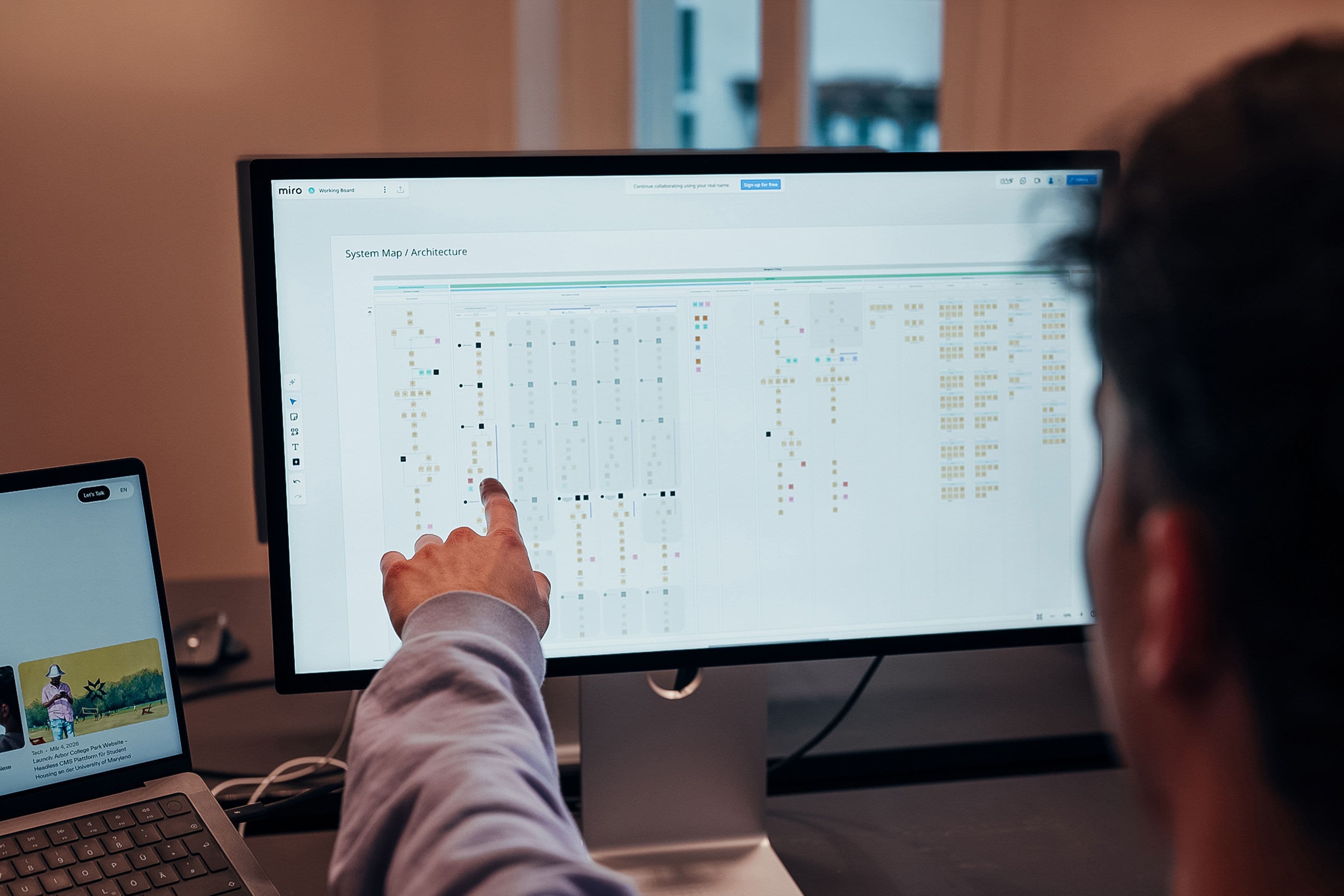
As the Nielsen Norman Group notes, system mapping serves not only for documentation but also for strategic planning. It visualizes the connections between user behavior and organizational processes. Depending on the objective, mapping can be divided into different categories. For implementation and ongoing development, it is essential to create high-quality, high-fidelity maps that accurately depict technical and functional details.
To keep a digital ecosystem maintainable in the long term, a systemic approach has proven effective. Continuous process and architecture mapping help maintain transparency regarding dependencies between user interaction, backend logic, and external interfaces at all times.
As the Nielsen Norman Group notes, system mapping serves not only for documentation but also for strategic planning. It visualizes the connections between user behavior and organizational processes. Depending on the objective, mapping can be divided into different categories. For implementation and ongoing development, it is essential to create high-quality, high-fidelity maps that accurately depict technical and functional details.
This visual model serves as a strategic tool for the entire team, allowing the impact of new requirements to be evaluated early and on a sound basis. This close integration of design and engineering prevents the system from becoming unstable under its own weight. The result is a robust platform that combines technological excellence with superior usability, sustainably reducing operational risk.
To ensure the long-term maintainability of a digital ecosystem, we have found that a systematic approach works best for us. Continuous process and architecture mapping helps us maintain transparency regarding dependencies between user interactions, backend logic, and external interfaces at all times. The success of a platform lies in the balance between agility and structure. Anyone digitizing complex B2C processes must think beyond the next feature and keep the long-term integrity of the entire system in mind.
A methodical approach that firmly anchors system mapping and user-centricity results in products that not only work today but can also be easily expanded tomorrow. Ultimately, a focus on clearly separating concerns and automating processes creates the flexibility companies need to remain innovative in dynamic markets and offer their users real added value.
At muse case, we combine methodological precision with fast, agile execution. Instead of isolated features, this results in a well-thought-out, validated solution that stands out for its clarity and is structurally prepared for future growth.
![[object Object]](/_next/image?url=https%3A%2F%2Fcdn.sanity.io%2Fimages%2Fqnbxd1h1%2Fproduction%2Facf01a4cce3bff0f6258bd5c237029bf4f057e22-1500x2000.jpg&w=3840&q=75)
Marc Schade
UX Designer

Convinced that we are the right ones for your project? Let's work together!

CEO
Contact us via email, and we will get back to you promptly.